Sallie Gardner: A Gallop Divided into Twelve Frames
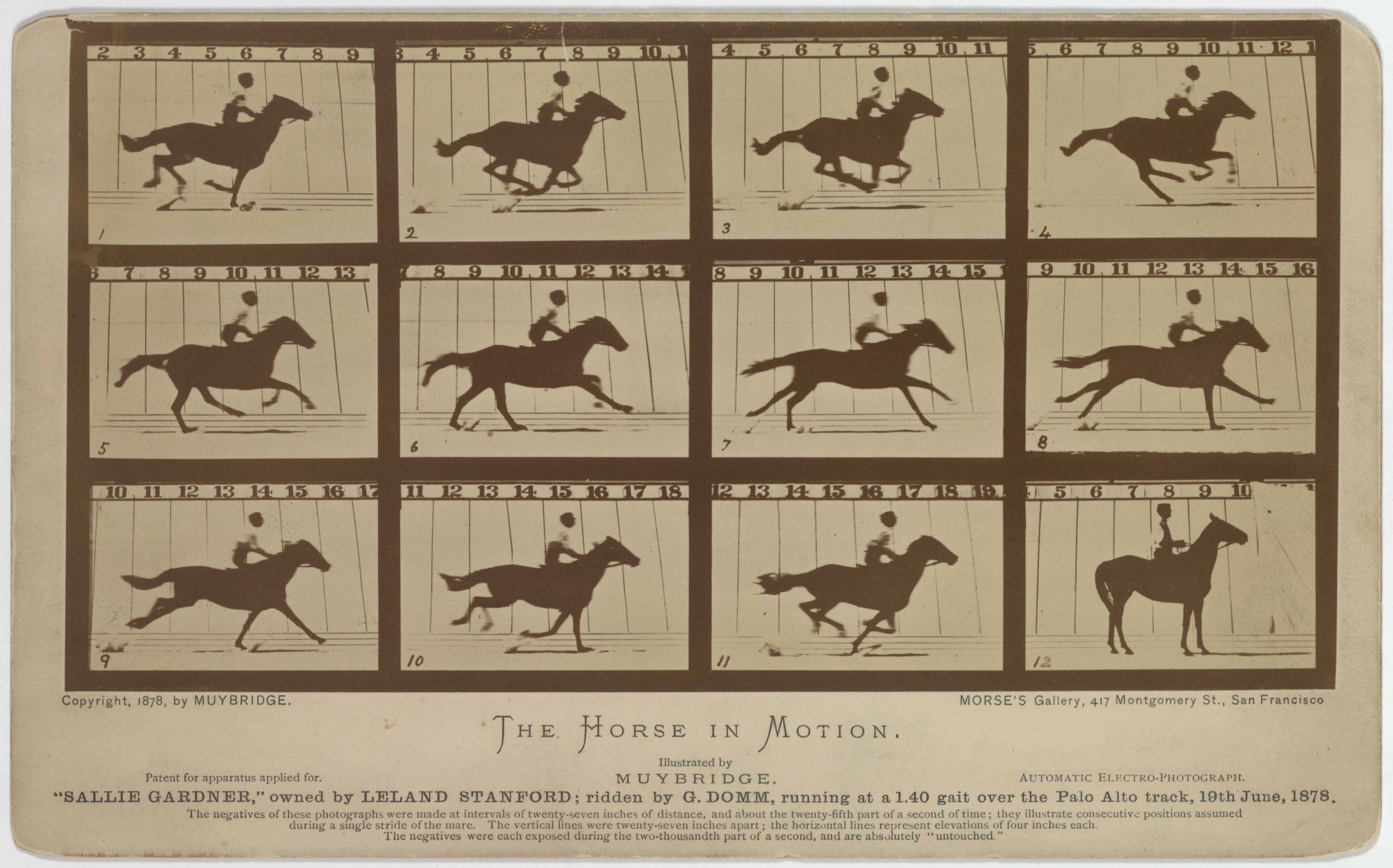
Eadweard Muybridge’s sequence of “Sallie Gardner”, recorded on 19 June 1878, divides a galloping horse into twelve distinct instants rather than freezing the movement in a single image. The photographs are arranged on one card in three rows of four. Horse and rider remain at a comparable scale across the frames, while the positions of the legs change. A brief movement becomes a set of small differences that can be compared side by side. The force of the card comes from more than the successive poses. Vertical measuring lines in the background, numbered frames and the explanatory text beneath them make it difficult to read these as casually captured photographs. Photography has become an instrument of observation. Keeping the horse’s body in a consistent visual field makes it possible to compare the angles of the legs, the transfer of weight and the contact of the hooves with the ground. Repetition is what makes each small difference visible. The work began with Leland Stanford’s question about whether a galloping horse ever lifts all four hooves clear of the ground. Muybridge used a series of cameras triggered in succession along the track to record the movement at separate instants. The resulting photographs revealed an airborne phase, while also challenging the familiar painted convention of a “flying” horse with forelegs and hind legs stretched in opposite directions. The shape of a body in rapid motion was not necessarily the shape that an observer imagined from continuous sight. Look more closely and the series is also solving a problem of graphic organisation. Each of the twelve images supplies incomplete information on its own; meaning emerges through sequence and comparison. Dark borders divide the frames decisively, numbers fix the order, and a repeated ground line gives the viewer a stable reference. Although the horse moves, the viewing field on the card remains controlled. Motion is therefore made legible through differences within a consistent arrangement. The sequence is often discussed in relation to the origins of cinema, but the printed card does not need to be mistaken for a projected moving image to remain compelling. Here, time is divided into parts that can be measured and studied before it is presented as a flowing picture. A further look might settle on the instant a hoof leaves the ground, the comparatively steady position of the rider, or the way the background grid turns an image into evidence. That combination of measurement and representation is what gives the object its continuing interest. Image: Eadweard Muybridge, The Horse in Motion (“Sallie Gardner”), 1878; Library of Congress / Wikimedia Commons, public domain.
View source ↗Back to references