Hokusai’s Kajikazawa: The Repeated Triangle
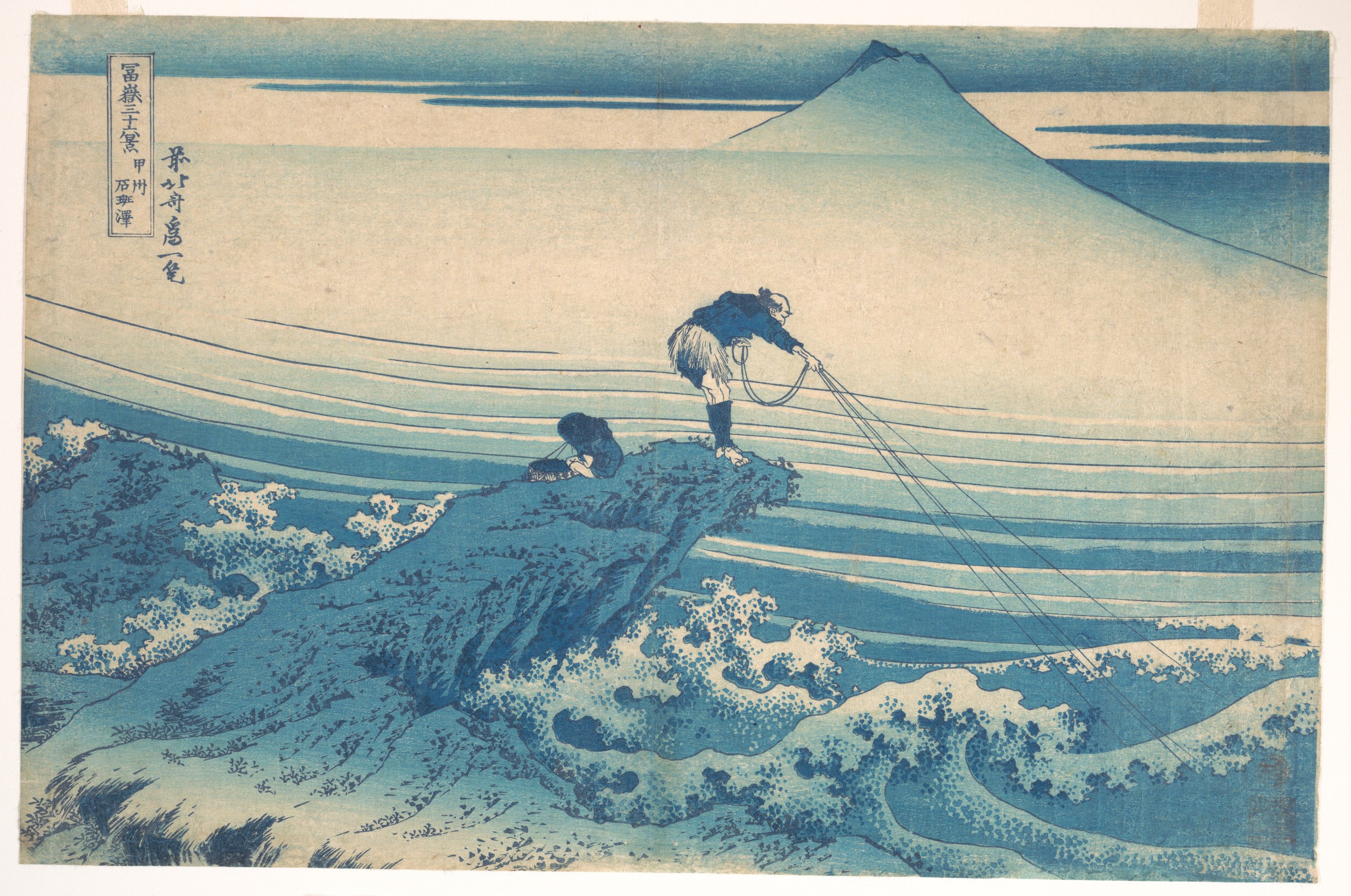
In Kajikazawa, from Hokusai’s Thirty-six Views of Mount Fuji, the immediate subject is an ordinary activity by a river: a fisherman leaning forward at the edge of a rock, a smaller seated figure beside him, and water moving below. Mount Fuji stands far away, almost quiet in the background. The print’s underlying structure lies in the formal relationship between these two very different scales. The fishing lines descending towards the water, the bend of the fisherman’s body and the pointed outcrop form a clear triangle. The slopes of Fuji repeat the same geometry at a distance. The eye does not simply travel from the foreground figure towards a deep horizon; it recognises one triangular arrangement in another. Rather than relying on a ready-made symbol of humanity and nature, Hokusai connects two separated spaces through a shared organisation of lines. Movement is equally controlled. The fine diagonals of the taut lines cross the near-horizontal bands of the river. Water runs in broad stripes, while the sharp projection of the rock pushes decisively to the right. The fisherman’s leaning posture continues that direction; the seated figure introduces a brief pause within it. Without enlarging a single dramatic gesture, the print conveys bodily weight and the river’s force through a remarkably economical sequence of contours. Colour strengthens these connections. Deep blue appears in the fisherman’s clothing, at the point of the rocky foreground and at the summit of Fuji, joining three otherwise distant parts of the image. Soft gradations across the open areas are held against the precision of the carved outlines. The blue emphasis of early impressions of the print is therefore doing more than describing atmosphere: it gives the image a visual structure across depth. The print measures only around 25 by 38 centimetres. Within that relatively modest surface, the sense of distance and movement comes from the relationships among a few decisive marks. Kajikazawa rewards another look because its most significant feature is not the grandeur of the landscape, but the way its lines meet and recur. Following the fisherman’s lines towards the water eventually returns the eye to the slopes of Fuji. Image: Katsushika Hokusai, Kajikazawa in Kai Province, ca. 1830–32; The Metropolitan Museum of Art, JP2581, public domain / CC0.
View source ↗Back to references