Tizio: Turning Balance into Mechanism
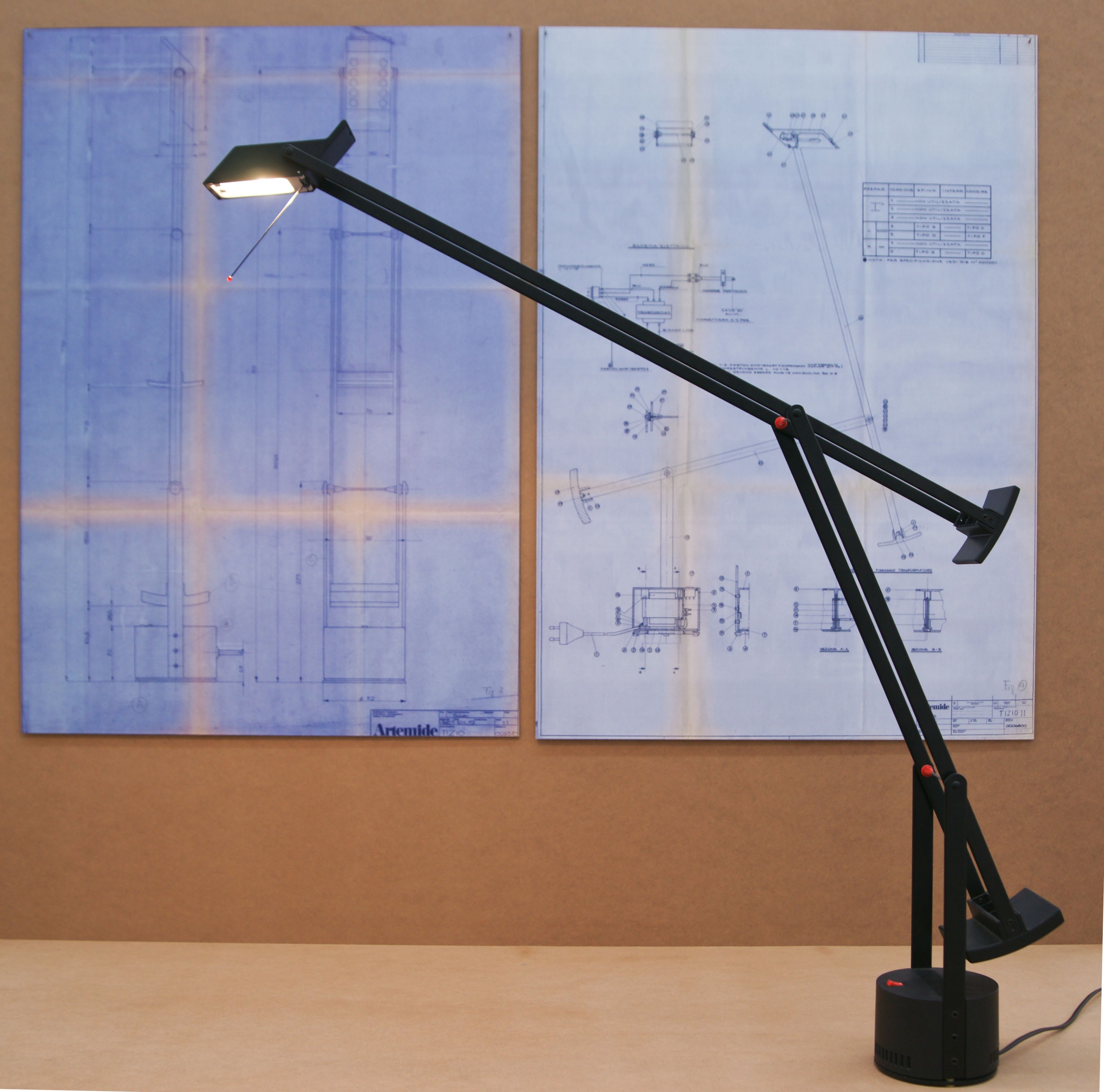
From a distance, Tizio first reads as a pair of thin black arms and an almost diagrammatic silhouette. Up close, however, its real subject is mechanism rather than form. In Richard Sapper’s desk lamp for Artemide, the base is not simply a support: it contains the transformer and acts as the centre of gravity. The two long arms do more than carry the light head; they also conduct electricity. No separate wire needs to run visibly along the structure. Support, power and movement are therefore resolved as one system. The most instructive part of the lamp is its counterweight arrangement. The proportions of the joints and weights allow the head to be repositioned with very little force and to remain where it is left. Long before “user experience” became a design phrase, this was a very physical ergonomic problem. Sapper wanted a work lamp that did not need to be clamped to the desk, could reach across a broad working area and still occupy little space at its base. Tizio turns that requirement directly into form: mass is concentrated low, while movement becomes progressively lighter above it. Using the arms themselves to carry current is not merely a technical trick. It is a decision that reduces visual noise. The lamp does not hide how it works; the forces, pivots and counterweights remain legible. Yet there is no unnecessary cable, spring or decorative component competing for attention. Tizio therefore becomes simple not by removing parts for the sake of a minimal appearance, but by asking each part to perform more than one task. That is a recurring quality in strong industrial design: visual economy arrives as the consequence of a well-resolved system. The small, concentrated light head follows the same logic. When the lamp entered production in 1972, a halogen source was still unusual in a domestic desk lamp. A compact reflector could deliver a precise, intense pool of light without requiring a large shade. That keeps the long arms visually light and preserves the sense that the lamp is more like an articulated instrument than a piece of furniture. The black structure and restrained red accents reinforce this reading. Colour is not decoration; it acts as a minor piece of interface information within the mechanism. Tizio is worth returning to not because it became an icon, but because it solves several difficult problems at once: balance, reach, power transmission, footprint and precise direction of light. Its character is not a style applied after those problems were solved; it emerges from the solution itself. More than fifty years later, it still does not need nostalgia to remain convincing. Its longevity comes from the clarity of the relationship between form and mechanism.
View source ↗Back to references