The Staggered Stair at Castelvecchio: Turning Passage into Detail
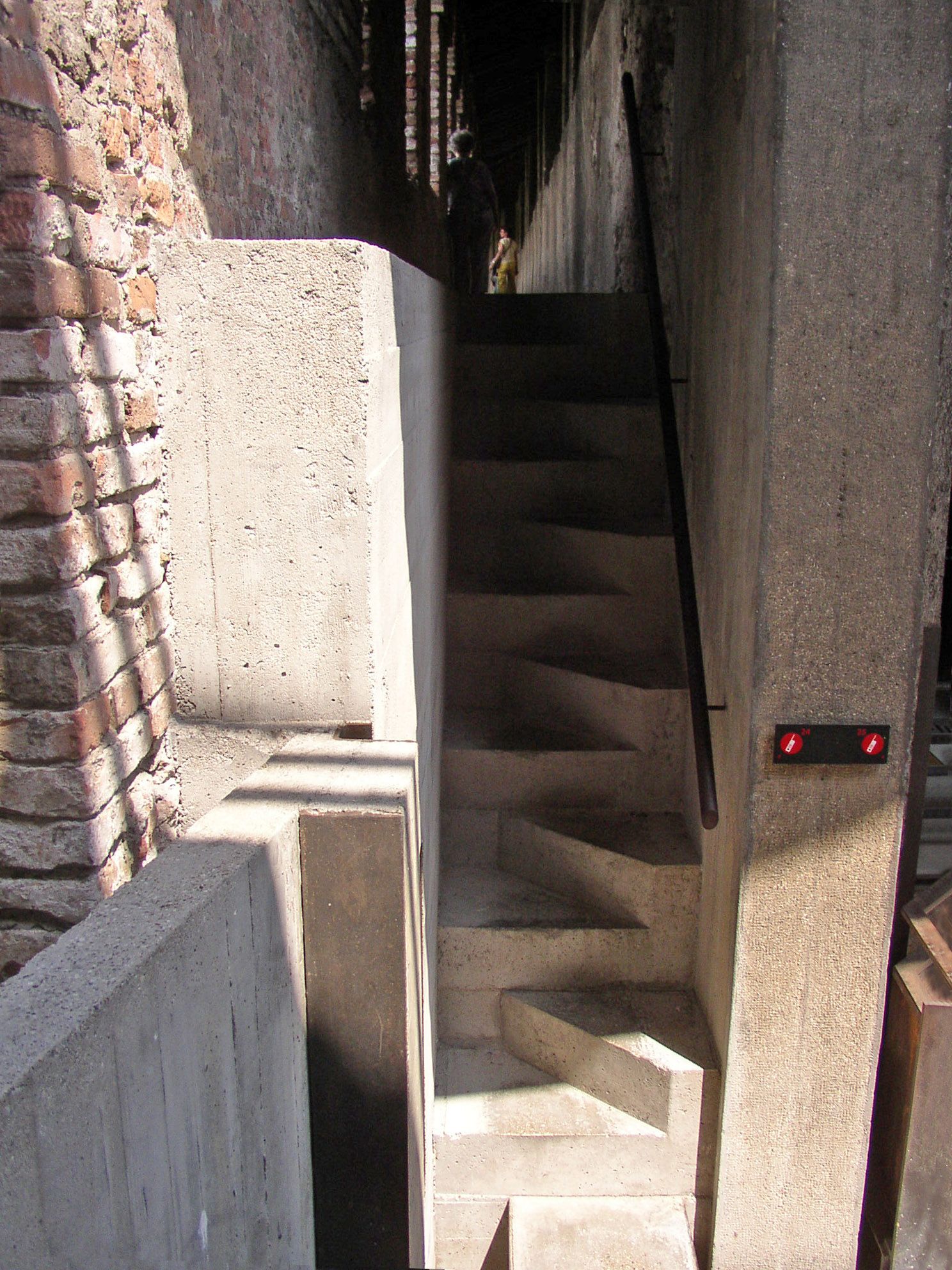
This small stair at Castelvecchio shows why Carlo Scarpa is remembered not only for large spatial decisions, but for the moments of transition between them. Its practical task is modest: it provides access to a semi-covered passage. Yet the stone treads do not rise as one regular flight. They are staggered, each step shifting slightly from the axis of the one below. That small displacement turns an ordinary piece of circulation into a threshold in which movement becomes perceptible. The asymmetry is not theatrical. At first it can almost appear incidental, but the stagger changes both the rhythm of walking and the way the stair meets the wall. A conventional flight could be read as one continuous diagonal. Here the individual treads remain distinct, so ascent is experienced less as a single gesture than as a sequence of small adjustments. The stair does not merely move the visitor to another level; it makes the act of transition itself part of the museum experience. Function and perception are not treated as separate problems. The detail also makes sense within the broader logic of Scarpa’s Castelvecchio restoration. He did not try to complete the historic fabric as if the new work had always been there, nor did he disguise contemporary interventions in a medieval language. New elements remain legible as new, while the weight and texture of the existing walls are allowed to retain their presence. In this stair, the clean geometry of the stone treads sits beside the irregular surface of old brick. The two periods are not forced into visual imitation; their contact makes each more readable. The same principle appears in the metal details. Thin, dark lines behave almost like drawing against the mass of stone and masonry. This contrast — heavy and light, rough and precise, old and new — is not decorative. It helps explain how the intervention has been assembled and which parts belong to different moments in the building’s history. Detail becomes a way of preserving historical legibility rather than merely refining appearance. What makes the stair worth returning to is its scale. A very small design decision is capable of expressing the attitude of the entire restoration. Conservation here does not mean imitation; it means allowing the new work to belong clearly to its own time without suppressing the old. A few displaced treads are enough to alter movement, sightlines and the relationship between materials. Scarpa’s strength often appears at precisely this level: the detail never becomes an isolated flourish, yet the larger architectural idea can still be read within it.
View source ↗Back to references