Apollo DSKY: A Language Built from Numbers
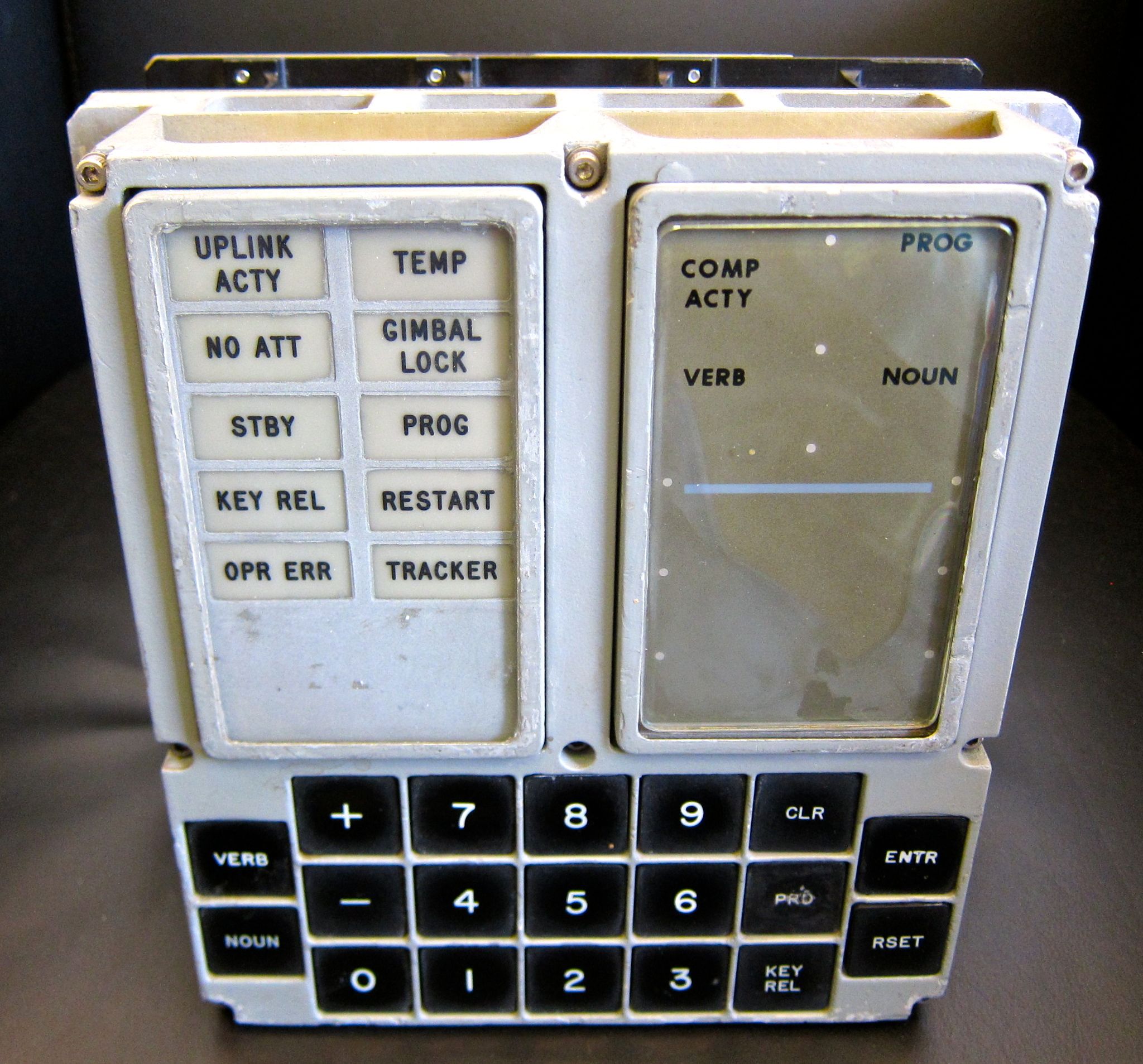
One of the most visible points of contact between the Apollo programme and its computers was the DSKY panel in the cockpit. The unit in this photograph was removed from a Command Module training simulator at Johnson Space Center. The worn edges, faded display surface and marks of use make it more revealing than a pristine catalogue image. It is an instrument built for the repetition of procedures, not for display. The front is divided into three clearly legible areas: status and warning indicators on the left, programme and numerical readouts on the right, and a keypad below. Two of the keys are labelled VERB and NOUN, an unusually direct account of how the interface works. An astronaut did not compose an instruction in ordinary language. A two-digit verb code identified the desired operation; a two-digit noun code identified the associated data. The computer was addressed through a deliberately limited, predefined vocabulary. By the standards of contemporary screens, very little seems to be present. Yet a small number of controls does not automatically make a system easy to use. DSKY codes had to be learnt, their meanings understood and the results checked against mission procedures. Complexity had not disappeared; much of it had moved into training, conventions and the sequence of work. The distinction matters whenever visual simplicity is confused with intuitive operation. The panel’s hierarchy is correspondingly precise. Dedicated indicators such as UPLINK ACTY, GIMBAL LOCK and OPR ERR are kept separate from ordinary numerical information. White labels against the dark keys distinguish the digits from operations such as VERB, NOUN, ENTR and CLR. Rather than presenting every possible choice at once, the interface communicates what action is being requested and what condition the system is in through a small set of unambiguous signals. Its visual restraint is inseparable from the discipline of the task. The reason to return to DSKY is more substantial than nostalgia for early computers. Each component makes visible a particular exchange of information between person and machine. The price is dependence on learnt codes and procedures. The gain is an interface in which command, response and error occupy recognisably different places, instead of dissolving into a single screen. The panel is small; the decisions passing through it were not. Photograph: Steve Jurvetson / Wikimedia Commons, CC BY 2.0. The image shows a DSKY unit removed from an Apollo Command Module training simulator.
View source ↗Back to references